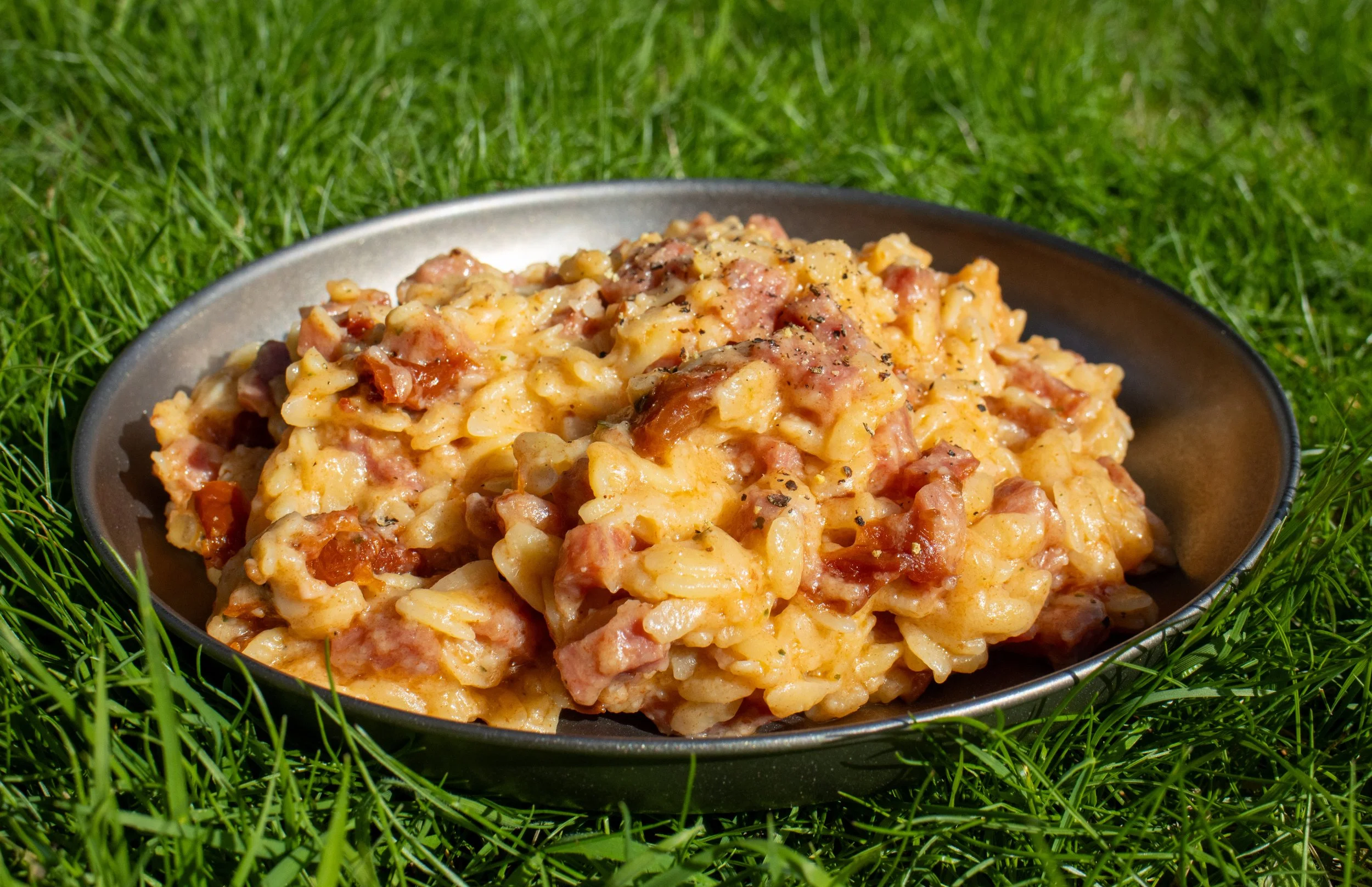
Adventure Orzo Alfonzie
Ok so this is going to take a little explaining. One evening when at home there was a little conversation over a rather tasty orzo al forno dish that went a bit like this:
Robert - “hmm I reckon we could make this at camp”
With Katrina following it up with - “so how would you bake it?”
Robert - “well maybe if we just get all the flavor in then we won't need to bake it”
Katrina - “doesn’t al forno mean baked in Italian?”
Robert - “I think you are right (furious googling)... yep it does”
Katrina - “you understand if we're writing a recipe for this we probably need to call it something different then?”
Robert - “What about Fonzie? He was from Wisconsin, so how about Orzo Alfonzie instead?”
Katrina - “errr, sure, I suppose”
And the name stuck.
If you have any better names for this dish, then please let us know.
We have been perfecting this recipe over a few months simplifying it in the kitchen and then moving to cooking outdoors. Having taken it on a couple of small adventures and tested it thoroughly, we now think we have it nailed and we are eager to share it with the world.
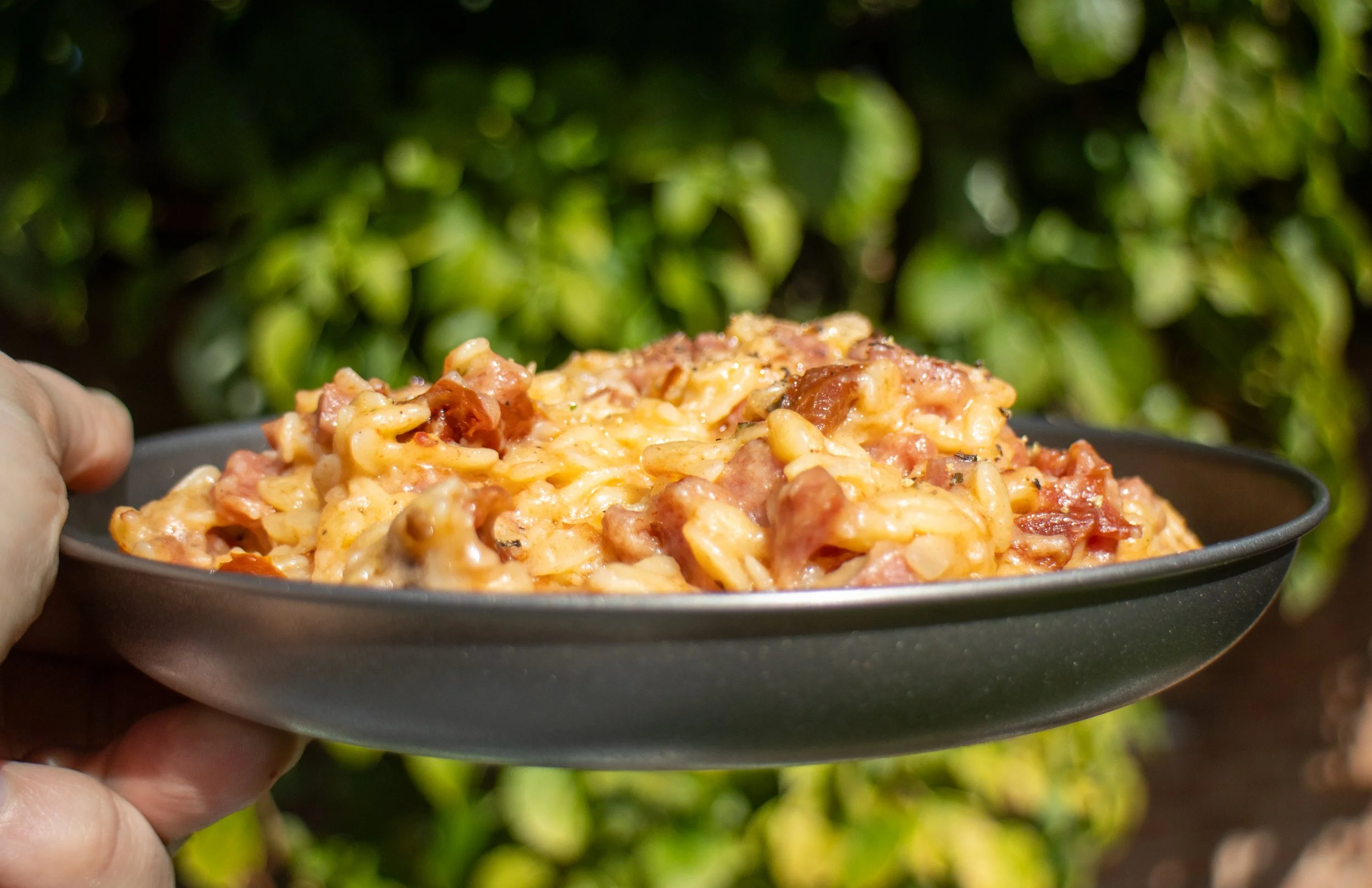
Ingredients
This recipe has some strange uses for ingredients, but trust us, the result is wonderfully stodgy, rich, and full of flavor. Just what you want if it is pouring with rain.
Core Ingredients
The core ingredients are a stable base that you can tweak and play with. Quantities given are for two hungry adventurers.
250g Saucisson (french sausage) - The key part here is that you want a cured sausage. We have tried a few different sausages and keep coming back to this one. The herbs and spices work well with the tomato and cheese.
440g Orzo - This has to be the fastest cooking pasta that we have found so far. It takes flavors well and provides a good stodgy carbohydrate.
1 teaspoon garlic powder - We normally go for powdered garlic as it travels better than raw garlic.
1 teaspoon chili flakes - We have found that flakes work better than powder in this recipe.
40g dried grated hard cheese - We tried without and the dish just does not feel or taste good. Also possible to grate some fresh hard cheese at home and carry in a small pot, it just won't last as long as dried.
1 single serving sachet of powdered tomato and basil soup - As far as ingredients go this is an odd one, but it works surprisingly well. Not only does it bring the tomato and basil flavor but also acts as a thickening agent.
2 tablespoons oil - Any cooking oil will do, however we tend to use vegetable oil due to the neutral taste.
Water (enough to cover the Orzo) - It is hard to put a volume on this, however if you start with enough to cover the orzo, you can then top up if necessary. Having some water on hand enables the sauce to be made with the packet of soup.
Optional Ingredients
Now this is where you can start experimenting. Some ingredients we have found that work well as toppings are:
Sun dried tomatoes - Having small intense bursts of tomato brings some variety to the dish. We have found that the best time to add these is just before the powdered soup as it gives them a short time to partially rehydrate.
Black pepper - we tend to carry black pepper during all our trips so a sprinkle of this at the end can round it out nicely.
Wild garlic - A green leafy herb that is commonly found around the UK. We have been known to collect a few leaves and shred for garnish.
Cooking Equipment
This is one that you can easily do in the wild.
Camping stove - Something that has a controllable heat is preferable. Although possible over a spirit burner it is a bit more of a challenge to not weld food to the bottom.
Large pan - If you are using a two person cook set then the largest pan.
Mixing spoon - something to mix the ingredients is needed.
Sharp Knife - Something that will cut through the saucisson.
Cutting board - It is helpful to have something to cut on.
Method
To put it simply, the method can be summarised as just adding ingredients to a pot in the right order at the right time. Nice and simple and feels way more fancy than it deserves.
Cut up the saucisson into approximately 4 mm cubes. This may take some time and don’t forget to see if the casing is edible before starting.
Add the oil to the pan and make sure it coats the bottom. Place on the stove over a medium heat.
When the oil starts to glisten, add the saucisson and stir almost continuously to ensure that the saucisson does not stick.
Once some of the fat has rendered out of the saucisson, add the garlic powder and chili flakes and stir to make sure all the spices and saucisson get to know each other.
Add the orzo and stir to get all the lovely flavored oil around the pieces of orzo.
Add enough water to cover and bring to a gentle simmer.
Keep stirring until the orzo is pretty much cooked.
Make sure there is enough water left that you can see it around the orzo and add the packet of soup. Within a few moments this will thicken the water to make a sauce.
If you had a little too much water you may want to simmer to reduce the sauce down.
Add the hard cheese and stir. The cheese will seemingly melt and disappear into the sauce.
Tuck in before it goes cold!
Trail Tips
The biggest tip we can give you on this one is don't skip the cheese. It does make a huge difference. We did try without it once and we were touch and go about eating it (yeah, it was that bad).
Also it is worth seeing packet soups as more than just soup when creating meals. They can be versatile sauce packets in their own right!