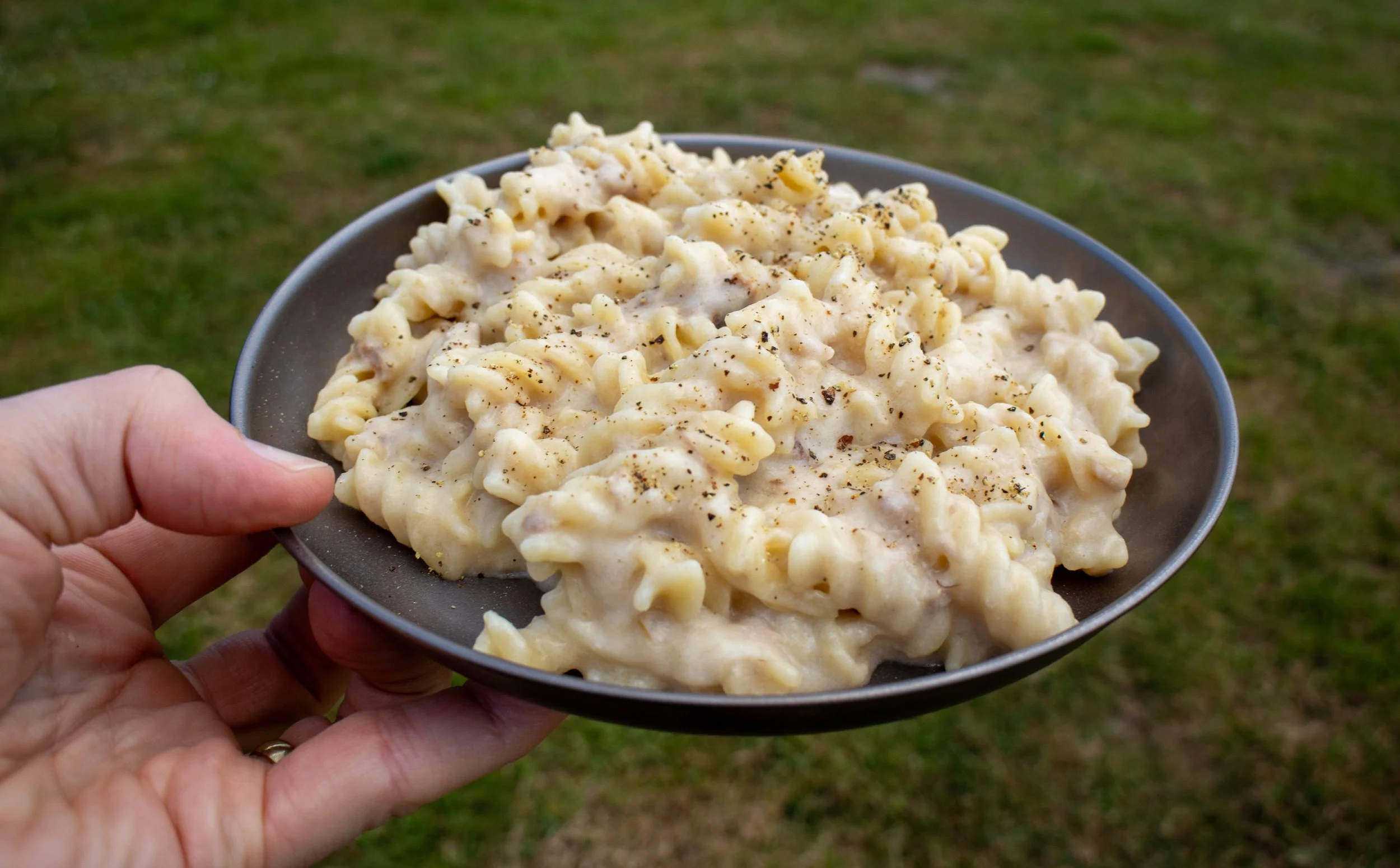
Tuna Pasta No Bake
Sometimes when on expedition you just want some stodgy comfort food. If at home it would be finished by baking, but as you're unlikely to have an oven whilst out in the wilderness (or even just at a campsite), you can just eat it without. All the constituent parts are suitably cooked before they'd go into an oven anyway.
This meal is easy, hot and sticks to the ribs. It is one of those meals that warms you from the inside, so perfect for a rainy evening after a hard day of activity.
Ingredients
This recipe has two options for the sauce: a quick one (if you can get the specifics stated), and a slower one which has much more readily available ingredients, but requires a bit more cooking ability.
Core ingredients
The core ingredients are a stable base that you can add whatever tweaks and twists to that you find along the way:
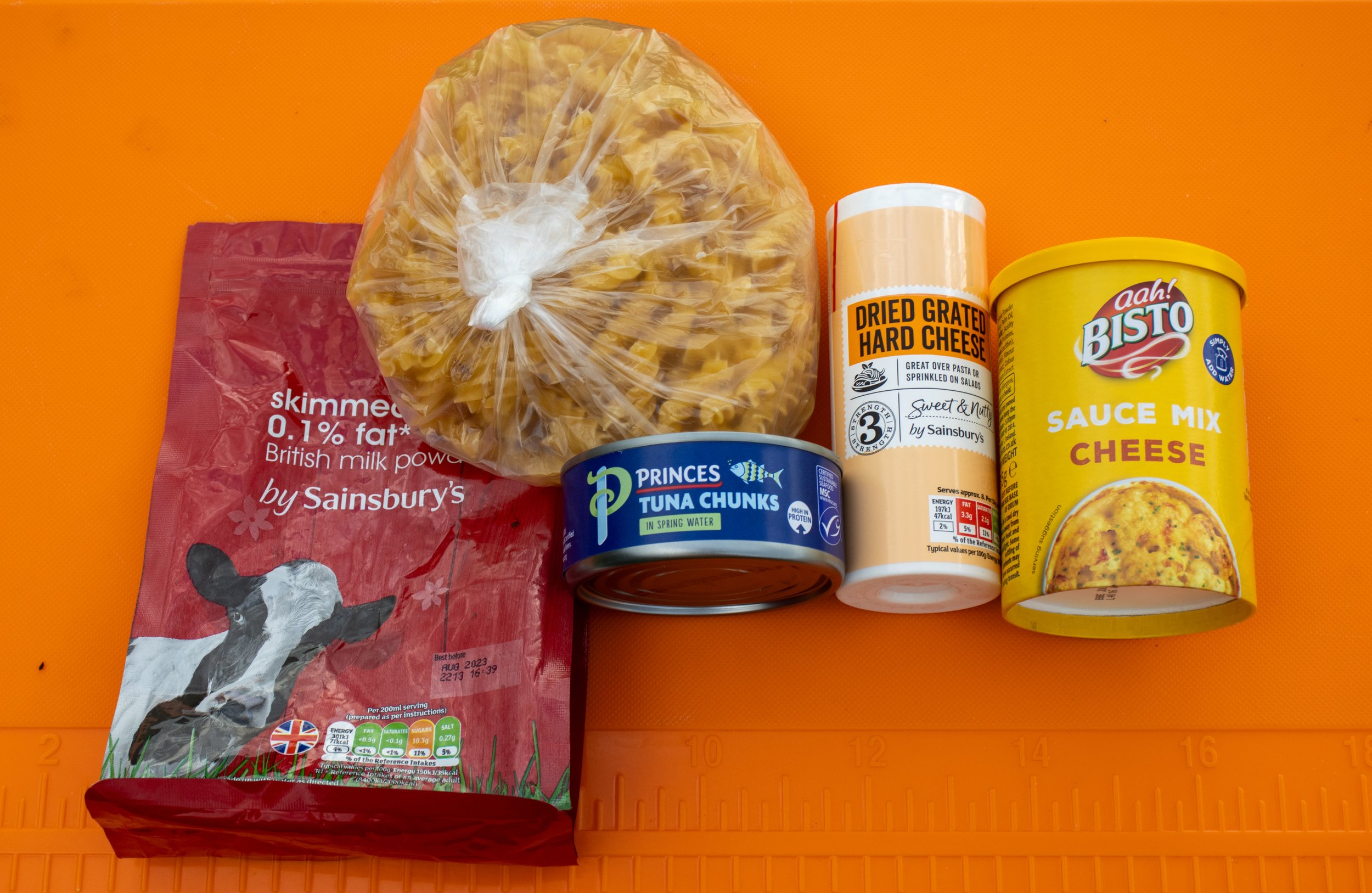
Quick cook pasta (2 servings) - The quicker cooking the better. The shape is almost irrelevant at this point.
Tuna (2 servings) - We have found that in many places it is possible to pick up tuna in packets rather than tins. This is the primary protein for the meal so serving size should be based on as much protein as you need, rather than the size stated on a packet.
Hard cheese (approximately 50 grams) - This makes the sauce super sticky and thick.
Water enough to cook your pasta - This is going to need to be enough to at least cover your dry pasta.
Neutral oil (1 tablespoon) - This is to stop the pasta from sticking together.
Option 1 (Quick)
Quick sauce option - For the quickest sauce we have found was a packet dry cheese sauce (by Bisto if you can believe it!) that you just add hot water to. However these sauces can be a bit difficult to get in more provincial supermarkets.
Option 2 (Accessible)
Neutral oil (2 tablespoons) - Something like vegetable oil.
Plain flour (4 tablespoons) - Simple plain flour.
Powdered milk (follow packet instructions for making equivalent of full fat milk) - About enough to make around a litre of milk, with the actual amount based on consistency in your dish.
Optional Ingredients
Now this is where you can start personalising to your own taste. We lean heavily on chili, turmeric, and black pepper. You can definitely use other combinations to suit your personal tastes, but here's ours:
Black pepper (1 teaspoon) - we tend to carry back pepper during all our trips so a sprinkle of this at the end can round it out nicely.
Turmeric powder (1 teaspoon) - This brings warmth and colour to the dish.
Chili powder (0.5 teaspoons) - Having a bit of spice adds a nice heat.
Onion bits (2 tablespoons) - These can be added as a garnish at the end to give a bit of crunch to the dish (this is definitely missed by not baking).
Cooking equipment
This is one that you can easily do in the wild.
Camping stove - Something that has a controllable heat is preferable. Although possible over a fire it takes a bit more work and close attention.
Large pan - If you are using a two person cook set then the largest pan.
Smaller pan - If you are using a two person cook set then the smaller of the pans. This will ironically be your saucepan.
Mixing spoon - something to mix the ingredients is needed.
Grater or Sharp knife- If you have a block of hard cheese.
Chopping board - To cut onto
Whisk (optional) - For making the accessible sauce this does make it a little easier to ensure you don't get lumps.
Method
Depending on your sauce option depends on how tricky this recipe is to put together. The method below has the two options split out.
Cook your Pasta
Take your large pan, fill with water and bring to the boil on the stove.
Add your pasta and cook for the recommended time needed for it to be al dente. If you over cook your pasta at this point then you may end up with a mush later down the line.
While waiting for your pasta to cook, grate or slice your hard cheese into thin slivers. If slicing, aim to get the slices as thin as possible as this will make it quicker for the cheese to melt into your sauce later in the recipe.
When your pasta is cooked, drain and make sure it has not stuck together in the pan.
Place a tablespoon of oil in your pasta and mix well, this will help to stop your pasta from becoming one solid lump. Keep the pan warm if you can whilst completing the other steps.
Make your sauce.
Easy sauce method
Take the smaller of your two pans and make the packet cheese sauce as instructed. Some may require milk, in which case you can do so using powdered milk.
If you are adding spices then you will want to add these to the sauce mix and stir to make sure there are no lumps.
Accessible sauce method
We are essentially going to make a Bechamel sauce but with oil rather than butter (this may be heresy in fine dining, but necessary on the side of a mountain!).
Make up a litre of milk as recommended on the packet of your powdered milk (whole milk consistency if it gives you the option).
Take the smaller of your two pans, add 2 tablespoons of oil and place over a low heat.
Add your flour to the pan and stir with your wooden spoon. The idea here is to cook out the flour without burning it. When the mixture has come together in the form of a paste and the flour has changed colour to a light brown (should only take a minute or two), proceed to the next step.
Add a little milk and stir or whisk until all the lumps are gone and you have a smooth mixture.
Repeat previous step until you have used all your milk and your sauce is smooth and thick enough to coat the back of a spoon.
If you are adding spices now is the time to add them to the sauce and make sure they are fully combined and not lumpy.
Combining your sauce and pasta
Pour your sauce over your pasta.
Add your tuna and mix thoroughly.
Add your sliced/grated hard cheese and stir to give an even distribution throughout the mixture. This will help thicken the sauce as well as giving or intensifying the cheesy taste.
Leave to stand for a few moments to let the hard cheese start to melt.
Serve and tuck in!
Trail tips
We will often use our pasta water to make packet soup for a starter. After all, you have probably carried that starch infused water and the fuels used to heat it. If you just toss it away there are calories you have just wasted.
We often top the dish with black pepper as it seems to taste better than adding it directly to the sauce.
We made this recipe in a dutch oven once on camp with great success. Right at the end we sat the lid ajar so the steam could get out, and put hot coals on the lid. This gave us a crunchy top that you would expect from a pasta bake made at home in the oven.