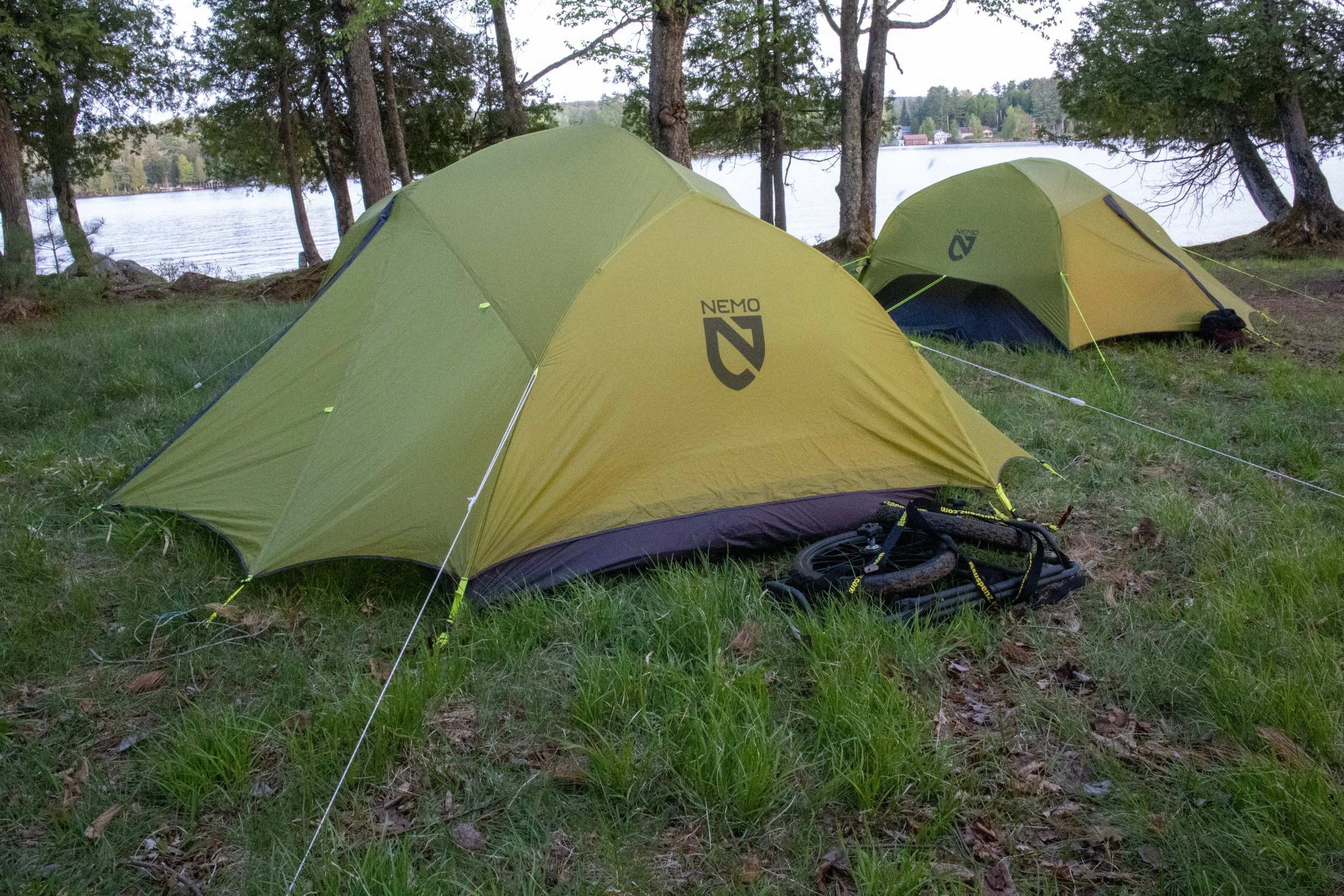
NEMO Equipment Dragonfly 3
TL;DR: A lightweight, spacious three-person tent coming in around the £390 mark, with some innovative features, however it struggles significantly in wind and rain, making it a fair weather only choice.
The claim on the label
When you go looking for a new piece of kit often the only information available is what the manufacturer or retailer supplies. We were looking for a lightweight tent for canoe expeditions where we could spend days on end waiting for bad weather to pass. We made our decision to get our Nemo Dragonfly 3 based on this information.
Manufacturer: Nemo Equipment
Product full name: Dragonfly 3
Price tag : £389.95 (Purchased March 2023)
Retailer: Absolute Snow
Key claims or standout information:
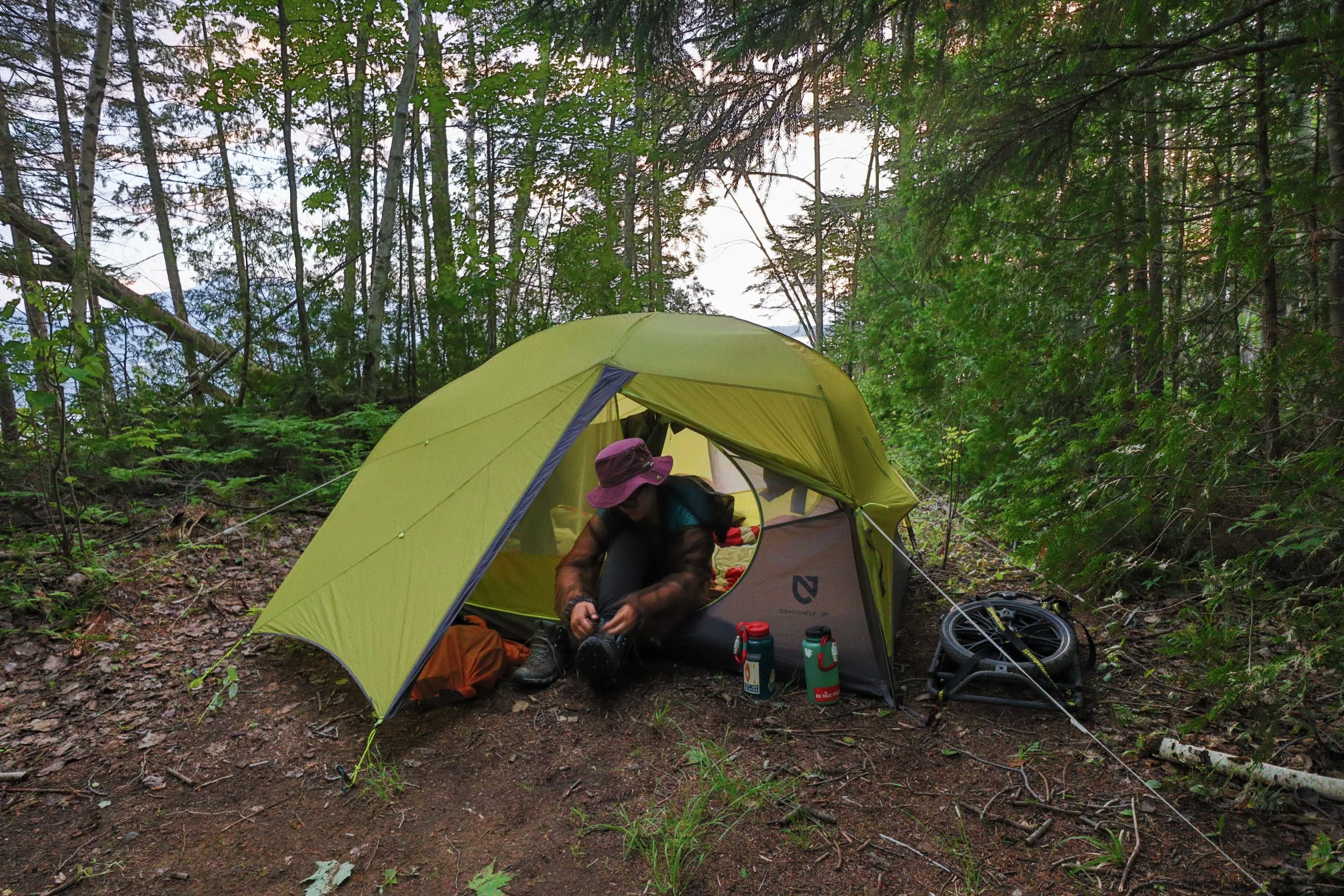
The inner has floor dimensions of 2.23m (88”) length with 1.78m (70”) at the head end and 1.65m (65”) at the foot end. The peak height 1.11m (44”) is approximately a third the way down from the “head” end.
The inner is freestanding and can be erected without pegs.
Colour-coded anodized poles and matched webbing for ease of pitching.
White no-see-um mesh on side panels adds privacy while a black mesh top offers clear stargazing at night.
Integrated 20D nylon tub provides an ultralight, waterproof floor, and premium 15D nylon ripstop fly is coated in a durable silicone repellent for reliable and durable weather protection.
Overhead Light Pockets for use with head torches.
Divvy Sack dual-stage stuff sack allows you to split the load with a hiking partner.
Strut vents at the top of each door flap to help with ventilation.
Out on the trail
We all know that manufacturers and retail staff's claims are all well and good but the real proof is in the use on the trail. We try to give you an understanding of how much we have used the equipment and more critically, in what conditions, before we cast judgement on its performance.
Estimated time of use so far: 80+ nights
Adventure we have used this on: The Great Glen, and the NFCT, with a few other smaller weekend adventures.
What we have used it for: Longer canoe trips where weight is a big concern.
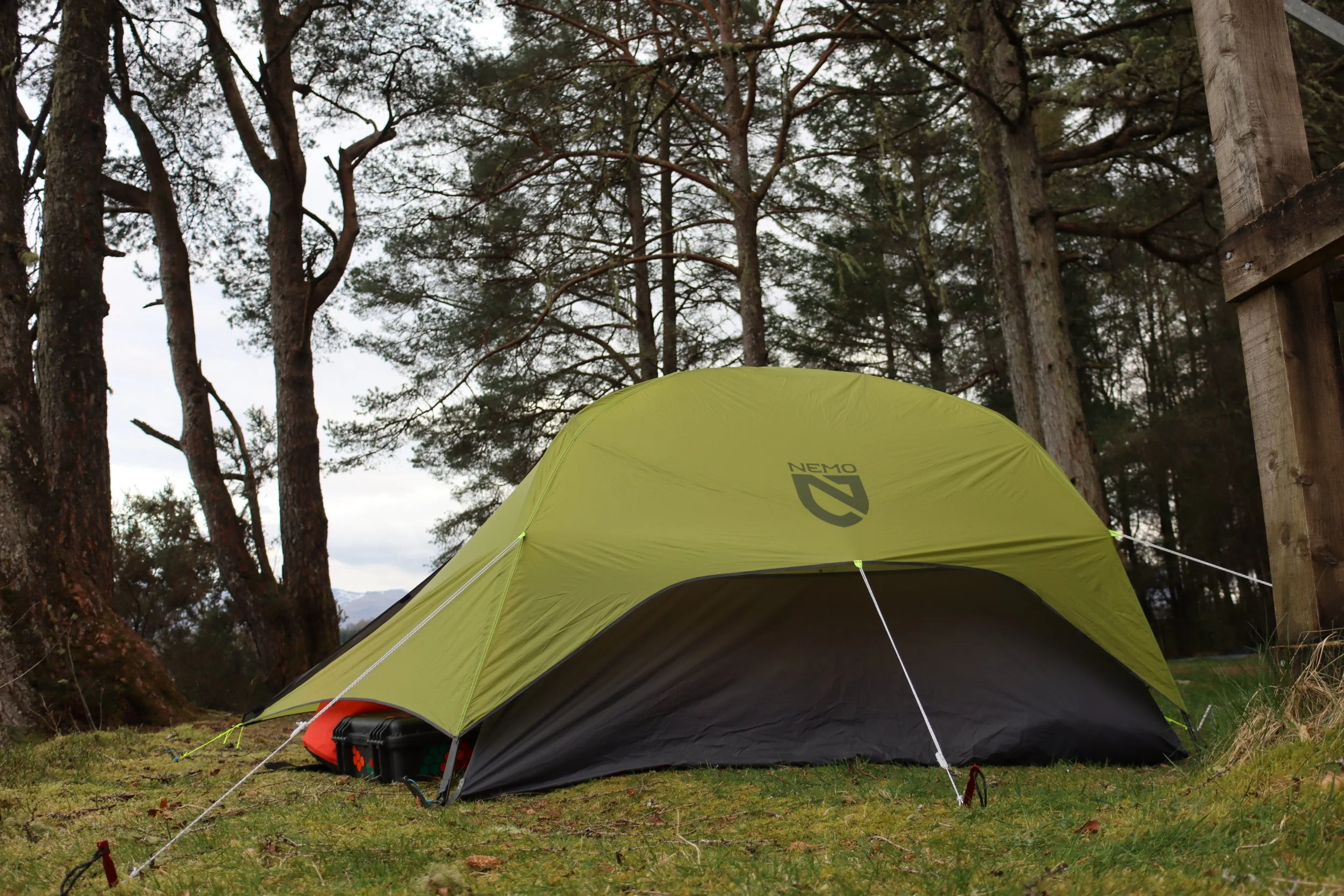
How has it performed: We very quickly found that this tent does not do well with wind. Probably due to the flat-ish sides and lack of guy points. Therefore we were very careful when pitching, trying to keep the wedge shape (foot end) towards the direction of the wind.
The tent is rather draughty inside, even in the most still weather there is still a gentle breeze within the inner which is fantastic when warm, but less so when the temperature drops. This was a major issue when we ended up on our Great Glen trip having a night below freezing with a flurry of snow. We could feel the wind blowing across our faces while in our sleeping bag.
Even after some 75+ times of putting it up and taking it down the tent has stood up well to all we have put it through with no damage or failings. The outer and groundsheet fabric has remained waterproof, the poles are intact, and all the zips still work.
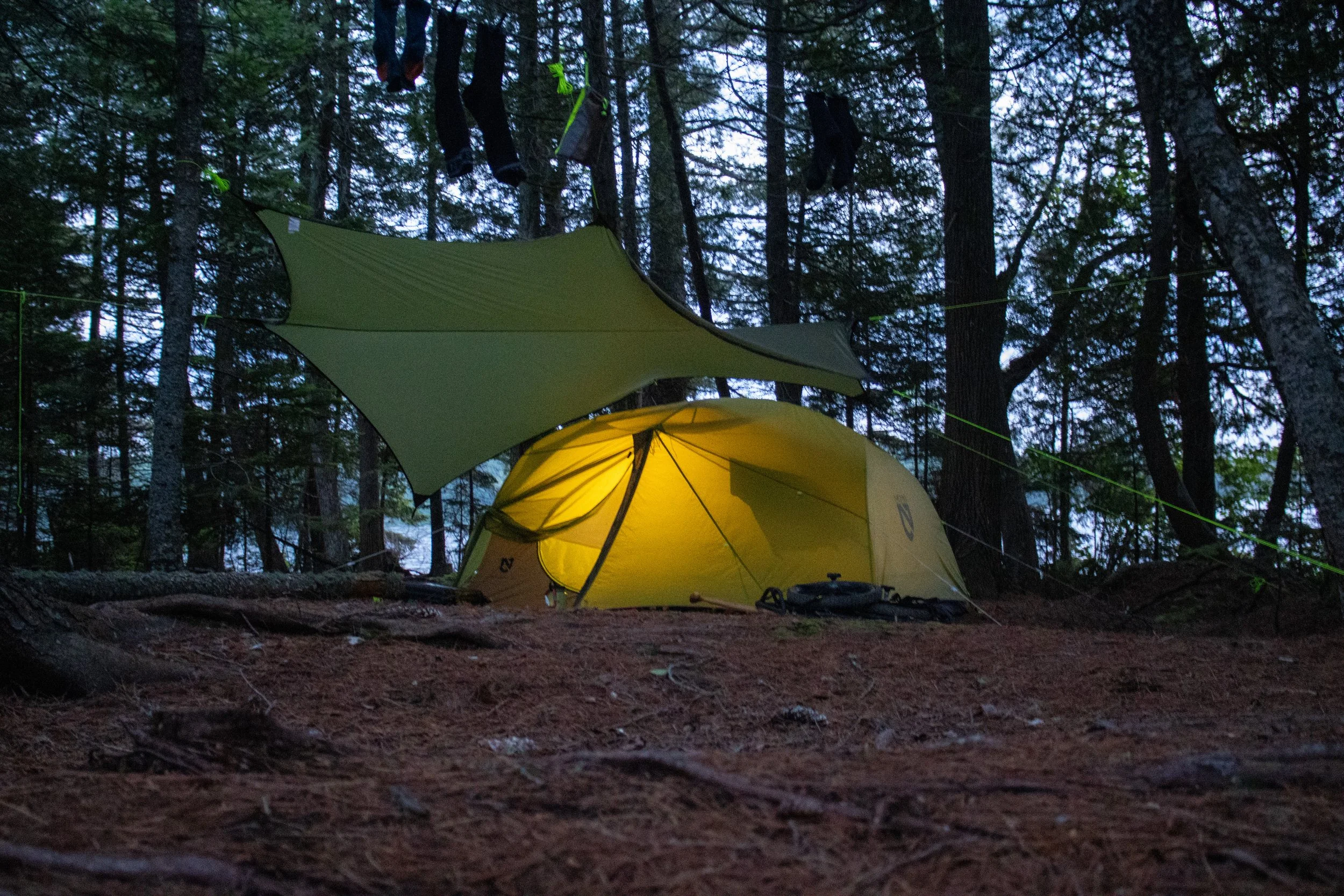
The outer fabric may still be waterproof, however in the wet it is almost impossible to get into or out of the tent without water dripping directly into the inner. This isn't an exaggeration; it's a design flaw. To counteract this, we started pitching the tent with a small tarp over the porch to keep the inner free from drips.
Any modifications made: We have added a cord around the inner to act as an internal washing line. This was much needed on our NFCT trip where it rained every day for a few weeks. The Divvy Sack dual-stage stuff sack did not work out for us and we replaced it with two dry bags.
Annoyingly, and perhaps most critically for a tent designed to be used on expedition, it does not come with any guy lines or the necessary pegs, despite having all the tie-points. Due to our experience on our Great Glen adventure, we immediately added our own guy lines to all of the attachment points and added the required pegs to the bag.
The good the bad and the packable
Being realistic there is no perfect piece of equipment, there are always pros and cons and so we try to give you our balanced view of what we feel about it and answer the question: does it make the packing list for our next adventure?
The bits we liked:
The weight for the size of space it gives us. There is plenty of room for both of us to get changed in at the same time. Also when traveling as a group it provides some redundancy of being able to accommodate a third person if needed.
For camping in the warm, this tent has a fantastic amount of ventilation.
The pocket in the roof of the tent we found fantastic for putting all of the stuff that we carry in our pockets throughout the day.
We thought that the light pockets were a bit of a gimmick but they genuinely work well at dispersing the light to provide a soft fill light in the tent at night. However as this tent is more suited to summer conditions we have not needed to use them all that much.
How it could be better:
A change in the design of the doors so when the outer fabric is wet and you are getting in and out it does not drip into the inner.
It is probably no surprise when looking at this tent that it may have issues with wind, however the extent to which it does is disappointing. Compared to the other tents we have recently used, this tent flaps, shakes, and generally does not feel as stable in the wind, even after adding the extra guy ropes. We think that it could be improved by taking the outer all the way down to the ground on all sides so the wind cannot get under it as easily. It may then also be possible with this extra fabric to change the shape slightly to shed wind better. We recognise that this may increase the pack weight slightly but it would probably be worth the piece of mind.
It is strange to us that a tent that costs over £300.00 does not come with guy ropes despite having the attachment points for them. Even if headline weight on the label is what you are chasing then at least have a max and min trail weight with the option to disregard the guy lines and additional pegs.
What we think it is best suited for:
Lightweight lowland summer adventures where you can be assured to be able to find a sheltered spot to pitch.
Are we going to pack it for our next adventure?: Depends, in the UK probably not, unless it is the height of summer. If we head to a part of the world where the weather is less wet and less windy, with the potential of being able to chuck a tarp up over the entrance, then maybe.
Does it get our seal of approval?
This tent has stood up well to our NFCT adventure, however, at the £390 price point, its flapping in wind and unfortunate dripping into the inner when getting in and out means it probably does not get our seal of approval. For a tent that we carry on our canoeing expeditions, we need one that we can erect in less than perfect circumstances, and still be confident it is going to keep us warm and dry regardless of the weather. The Dragonfly 3 is a great tent for dry, sheltered spots, but it doesn't meet our standard for serious expedition use.